Portable projectors used to be more trouble than they were worth: dim images, fiddly focus, and glitchy “smart” features that barely worked. That’s changed.
Today’s models use brighter laser tech instead of old LEDs, and smart auto-setup handles focus and alignment almost instantly. Built-in platforms like Google TV or Tizen mean you can stream Netflix, Disney+, or YouTube without extra devices.
Setup is now genuinely quick: set it down, turn it on, and within seconds you’re ready to watch. Whether you want a 120-inch movie night outdoors, a portable gaming screen in a hotel, or a big display without a bulky TV, modern portable projectors finally deliver solid performance at every price point.
Best Portable Projectors for Travel, Home Cinema, Gaming, and Bedroom Use
The five projectors below cover the full range, from a soda-can-sized laser pocket projector with Google TV and a 2.5-hour battery, to a 4K smart projector with Harman Kardon speakers that delivers a cinema-quality image in a package small enough to move between rooms.
Each was chosen based on image brightness, auto-calibration reliability, smart OS performance, and how well the feature set fits a specific use case and living situation.
1. Nebula Capsule 3 Laser
The best overall portable projector

The Capsule 3 Laser fits in a jacket pocket and delivers a 120-inch image. That combination has defined the portable projector category for years, and the laser light source is what separates the Capsule 3 from the LED-based pocket projectors that cluster around it at similar prices.
Laser produces higher contrast ratios and more saturated color than LED at equivalent brightness figures, which means the 300 ANSI lumens here performs more visually than competitors quoting similar numbers from LED sources.
Google TV is the right smart OS for a device like this. Netflix certification means the streaming quality isn’t compromised by sideloading workarounds, and the interface responds quickly enough that navigating content doesn’t feel like a chore.
USB-C charging means the same cable and power bank you carry for your laptop keeps the Capsule 3 running through a full outdoor session.
At 2.1 lbs, the weight is genuinely backpack-appropriate rather than just technically portable.
Type: Smart pocket projector | Key specs: 1080p resolution, 300 ANSI lumens, 120-inch max screen, 2.5-hour battery, Google TV (Netflix certified), USB-C, 2.1 lbs
Pros:
- Laser light source produces higher contrast and more saturated color than LED competitors at equivalent brightness ratings, making the 300 ANSI lumens perform above its number
- Google TV with certified Netflix integration streams without workarounds or quality compromises
- USB-C charging works with standard laptop power bricks and high-capacity power banks, removing the need for proprietary cables in travel scenarios
Cons:
- 300 ANSI lumens is insufficient for ambient-light environments and daytime indoor use without darkening the room significantly
- Built-in speaker handles casual listening but loses bass response and volume headroom at larger screen sizes, where the sound needs to fill more space
Verdict: The most refined all-in-one portable cinema experience available. For frequent travelers, campers, and anyone who wants a complete streaming setup that fits in a bag without planning around it, the Capsule 3 Laser is the obvious starting point.
2. XGIMI Horizon Pro 4K
The best premium performance

The Horizon Pro makes one concession to portability: it doesn’t have an internal battery. In every other respect, it competes with projectors that cost significantly more and stay permanently installed.
Native 4K resolution at 1,500 ISO lumens is the specification combination that separates this from the rest of the portable category, and the image quality difference at screen sizes above 100 inches is noticeable compared to 1080p units.
The AI auto-keystone correction is the fastest on this list. Point the projector at a surface at an angle and the image squares itself in under a second, which makes room-to-room relocation genuinely effortless rather than requiring a recalibration session each time.
Harman Kardon speaker integration means the audio holds up at the screen sizes the 4K image quality encourages, without requiring a separate Bluetooth speaker.
At 6.4 lbs, it requires a bag rather than a pocket, but the footprint is compact enough to sit on a bookshelf or nightstand without dominating the space.
Type: Smart portable home theater | Key specs: 4K native resolution, 1,500 ISO lumens, HDR10, Android TV 10.0, Harman Kardon speakers, 1.2:1 throw ratio, 6.4 lbs
Pros:
- 4K native resolution at 1,500 ISO lumens produces a genuinely sharp, well-lit image at screen sizes above 100 inches, where 1080p starts to show its limits
- AI auto-keystone correction squares the image in under a second, making repositioning between rooms or surfaces a one-second operation rather than a manual alignment process
- Harman Kardon speakers deliver audio quality that matches the image performance without a separate speaker purchase
Cons:
- No internal battery means it requires a wall outlet or a high-capacity power station for any outdoor use, limiting true portable deployment
- 6.4 lbs is heavier than every other projector on this list, and the weight is noticeable when carrying it between locations regularly
Verdict: The right projector for users who want a 4K cinema experience in a package that stores in a cabinet and moves between rooms without a professional installation. For glamping with a power station or as a secondary display in a bedroom or basement, the image quality is difficult to match at this size.
3. Epson EpiqVision Mini EF12
The best for brightness and gaming

Epson’s 3LCD technology is the feature that matters most for daytime use and gaming. Single-chip DLP projectors, which dominate most of this list, can produce a rainbow effect during fast motion for users sensitive to it.
3LCD eliminates that by passing light through three separate panels simultaneously rather than cycling colors sequentially. The result is more consistent color rendering during fast motion, which matters both for gaming content and for sports and action sequences in movies.
At 1,000 lumens across both color and white brightness channels, the EF12 handles ambient room light better than any other projector on this list. A table lamp on in the room doesn’t wash out the image the way it does on lower-brightness units.
The Yamaha speaker system produces audio that’s noticeably better than what most portable projectors of this size include, covering mid-range clarity and enough volume to fill a medium-sized room without distortion.
The cube design is less packing-friendly than cylindrical or flat alternatives, but the brightness and audio tradeoff is worth it for users who prioritize image quality in non-dark environments.
Type: Smart streaming laser projector | Key specs: 1080p resolution, 1,000 lumens (color and white), Yamaha audio, Android TV, HDR, 4.7 lbs
Pros:
- 3LCD technology eliminates the rainbow effect that DLP projectors produce for sensitive viewers during fast motion, making it the better choice for gaming and action content
- 1,000 lumens across both color and white brightness channels handles ambient indoor light without the image washout that lower-brightness units struggle with
- Yamaha speaker system delivers mid-range clarity and room-filling volume that outperforms every other speaker system on this list
Cons:
- Cube form factor packs less efficiently than cylindrical or flat projectors, and the shape makes it harder to position in tight spaces or unusual angles
- No internal battery requires a power source for all use, ruling out battery-powered outdoor sessions without a power station
Verdict: The most capable projector for daytime and gaming use on this list. The 3LCD brightness advantage and Yamaha audio make it feel like a full-featured home projector that happens to be compact rather than a portable device with compromises.
4. Samsung The Freestyle (Gen 2)
The best for flexibility and design
The Freestyle’s 180-degree rotating stand is not a gimmick. It changes the range of surfaces a projector can usefully address: floor, wall, or ceiling all work from a single placement without repositioning the unit or buying additional mounting hardware.
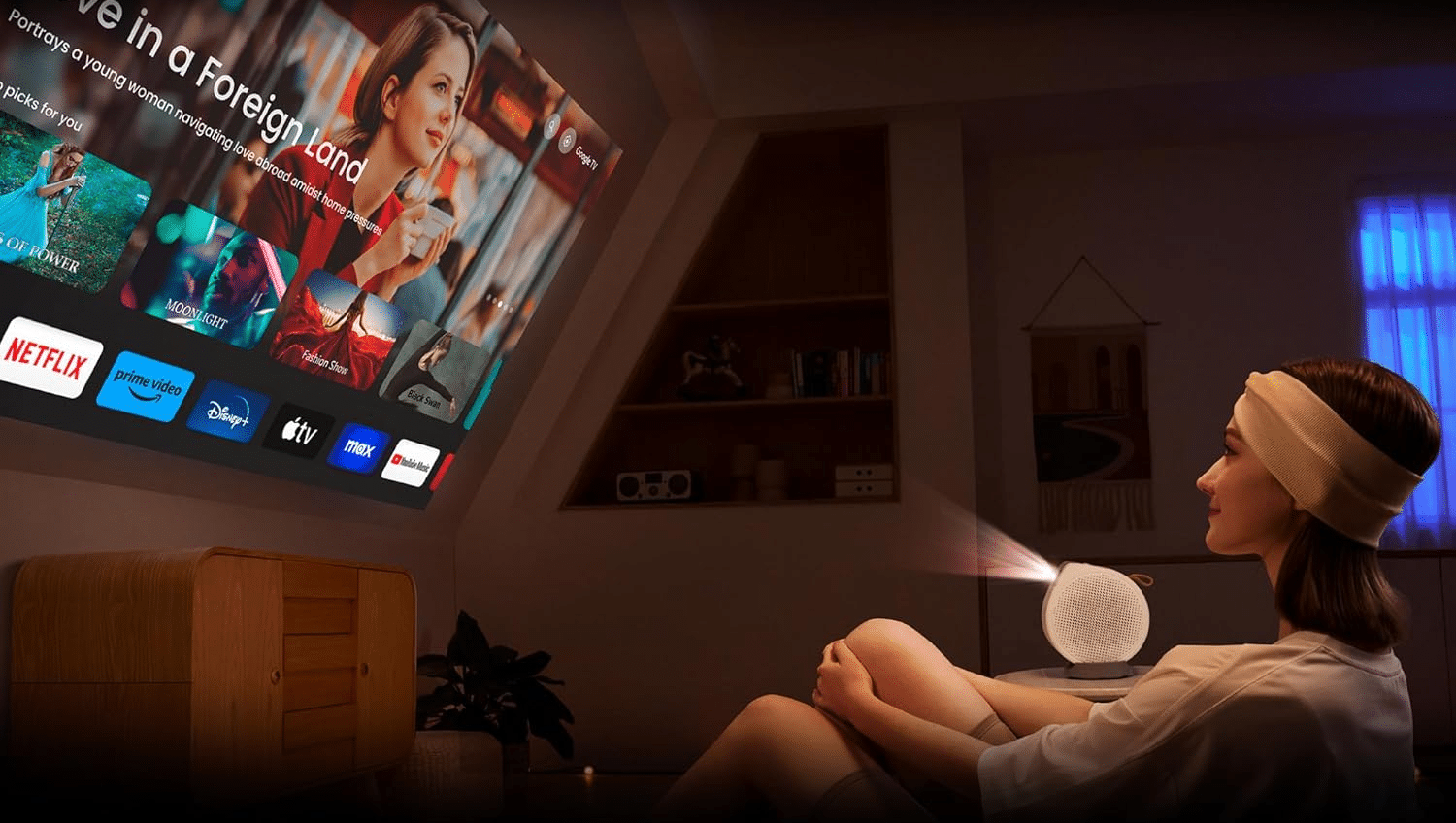
Ceiling projection for bedtime viewing is where this feature gets the most use, and the automatic keystone correction handles the extreme angle that ceiling projection requires without manual adjustment.
Tizen OS is Samsung’s smart platform, and it covers the major streaming services natively. The interface is functional, though it feels less fluid than Google TV during app switching and content discovery.
The Freestyle supports external USB-C power banks, which means it can operate off-grid using the same battery you carry for travel electronics rather than requiring a dedicated power station.
At 1.8 lbs, it’s the second lightest projector on this list, and the cylindrical shape packs efficiently in a bag.
Type: Flexible smart projector | Key specs: 1080p FHD, HDR10, 360-degree sound, Alexa built-in, Tizen OS, micro-HDMI, 1.8 lbs
Pros:
- 180-degree rotating stand covers floor, wall, and ceiling projection from a single placement, eliminating the repositioning that fixed-angle projectors require for different surface orientations
- USB-C power bank compatibility enables off-grid use with standard travel battery packs rather than requiring a dedicated power station
- 1.8 lbs and cylindrical form factor make it one of the most packable projectors on this list for travel scenarios
Cons:
- Lower brightness than the XGIMI and Epson options limits its usability in rooms with ambient light, pushing it toward dark room or nighttime-only use
- Tizen OS navigation feels less responsive than Google TV during app switching and content library browsing
Verdict: The most versatile projector for apartment living and bedroom use. The rotating stand genuinely expands where and how the device can be used, and the lightweight USB-C power bank compatibility makes it the most travel-ready design on this list after the Nebula Capsule.
5. BenQ GV50
The best for outdoor and bedroom comfort

The GV50 is designed around how most people actually use a portable projector at home: placed on a nightstand or coffee table, angled toward whatever surface is convenient, with audio that doesn’t require supplementing with a Bluetooth speaker.
The rotating base handles positioning without propping the unit on books or improvised stands, and the dedicated ceiling mode adjusts the image geometry automatically for overhead projection.
The built-in woofer is the audio differentiator that separates the GV50 from the Nebula Capsule and Samsung Freestyle. Bass response is noticeably more substantial than what small-driver projector speakers typically produce, which changes the movie-watching experience in a bedroom setting where external speakers aren’t always practical.
Google TV provides the same smooth smart platform as the Nebula Capsule, and Wi-Fi 6 handles 4K streaming content without the buffering that slower wireless connections introduce during high-bitrate scenes.
Type: Laser portable projector | Key specs: 1080p native, 500 lumens, Google TV, 4K content support, rotating base, built-in woofer, Wi-Fi 6, 2.5-hour battery
Pros:
- Built-in woofer delivers bass response that meaningfully outperforms the small-driver speakers in every other projector on this list, improving the audio experience for bedroom movie sessions without a separate speaker
- Rotating base handles surface positioning and ceiling angle adjustment without improvised support structures or manual tilt management
- Google TV with Wi-Fi 6 streams 4K content smoothly and navigates apps with the same responsiveness as the Nebula Capsule
Cons:
- 500 lumens at high brightness setting reduces battery life to a level that may not cover a full feature film, requiring a charging compromise during longer viewing sessions
- Mid-range brightness isn’t strong enough for large outdoor screens in anything other than full darkness
Verdict: The most comfortable home-use portable projector on this list for bedroom and intimate backyard sessions. The woofer audio and rotating base address the two areas where competing portable projectors make the most noticeable compromises, and Google TV keeps the smart platform competitive with the best options in the category.
How to Choose the Best Portable Projector
Resolution: Is 4K actually necessary?
For screen sizes under 100 inches, the difference between native 4K and 1080p is marginal at normal viewing distances. The pixel density at 80 to 90 inches from a comfortable seating position doesn’t resolve into a visible quality gap for most viewers.
At 120 inches and above, particularly for content that’s been mastered in 4K, the sharpness difference becomes noticeable.
For most portable projector use cases, 1080p is the right balance of image quality, battery efficiency, and price. 4K is worth the premium, specifically for users who plan to regularly project at large screen sizes with native 4K source content.
Lumens: ANSI vs. ISO and what the numbers mean
Brightness is measured in two standards that aren’t directly comparable. ANSI lumens is the older standard; ISO lumens is more stringent and produces lower numbers from the same light source. A projector rated at 300 ANSI lumens and another rated at 300 ISO lumens are not equally bright, with the ISO-rated unit typically brighter in practice.
For dark rooms and nighttime outdoor use, 300 to 500 lumens is sufficient. For rooms with table lamps on, 800 lumens or above is the practical threshold. For daytime visibility with windows open, 1,000 lumens is the minimum worth considering.
Throw ratio and auto keystone correction
The throw ratio determines how far back the projector needs to sit from the screen to produce a given image size. A 1.2:1 throw ratio means the projector needs to sit 1.2 feet back for every foot of screen width. Short-throw projectors with ratios below 1.0 can produce large images at close viewing distances, which matters in small rooms.
Auto keystone correction uses sensors and AI processing to detect projection angles and square the image automatically. Without it, any non-perpendicular placement produces a trapezoidal image that requires manual correction every time the projector is moved.
USB-C and power flexibility
USB-C Power Delivery support is the connectivity feature that most directly affects how and where a portable projector can be used. A projector that charges and powers via USB-C works with the same power bank you carry for your laptop, extends outdoor runtime without a dedicated power station, and reduces the total cable and adapter count for travel.
For battery-equipped models, USB-C also handles in-session charging, allowing a high-wattage power bank to extend a session beyond the built-in battery capacity.
Comparison Table
| Model | Brightness | Resolution | Battery | OS | Best feature |
| Nebula Capsule 3 | 300 ANSI | 1080p | 2.5 hours | Google TV | Size (soda can) |
| XGIMI Horizon Pro | 1,500 ISO | 4K | None | Android TV | 4K image quality |
| Samsung Freestyle | 230 ANSI | 1080p | None* | Tizen | 180-degree rotation |
| BenQ GV50 | 500 lumens | 1080p | 2.5 hours | Google TV | Deep bass woofer |
| Epson EF12 | 1,000 lumens | 1080p | None | Android TV | Color accuracy |
*Supports external USB-C battery packs.
Which One Should You Buy?
For the most complete portable cinema experience with built-in battery, Google TV, and laser image quality in a pocketable form factor, the Nebula Capsule 3 Laser is the clearest recommendation for travelers and campers.
For users who won’t compromise on resolution and want native 4K with Harman Kardon audio in a package that stores in a cabinet, the XGIMI Horizon Pro delivers image quality that no other portable projector on this list can match.
For bedroom ceiling projection and home use, where rotating stand flexibility and woofer audio matter more than raw brightness, the Samsung Freestyle and BenQ GV50 are the two most practical picks, depending on whether design versatility or audio performance is the higher priority.
For daytime visibility, gaming use, and ambient light environments where brightness and color accuracy are the deciding factors, the Epson EF12‘s 3LCD technology and 1,000-lumen output lead the category.
Frequently Asked Questions
Are portable projectors worth buying?
For dark bedroom use and nighttime outdoor viewing, yes. The gap between portable and stationary projectors has narrowed significantly with laser light sources and AI calibration.
A portable projector won’t replace a high-end TV in a bright living room, but for creating a large screen experience in a dark room or outdoors at night, current portable models deliver results that would have required a much larger and more expensive unit five years ago.
Can portable projectors actually replace a TV?
In a controlled dark environment, a good portable projector produces a more immersive experience than most flat-panel TVs at comparable cost, simply because the screen size is larger.
In a room with windows, overhead lighting, or direct sunlight, a modern LED TV wins on brightness and contrast without question. The practical answer is that portable projectors complement a TV setup for specific use cases rather than replacing it across all situations.
What brightness do I need for outdoor viewing?
For nighttime outdoor use with no competing light sources, 300 ANSI lumens produces a satisfying image. For twilight viewing where ambient light is present, 800 lumens or above handles the transition from dusk to full dark without the image washing out as the sun sets.
Full daylight outdoor viewing requires 2,000 lumens or more, which is beyond the current capability of battery-powered portable projectors.
Do portable projectors support Netflix natively?
The Nebula Capsule 3, BenQ GV50, and Samsung Freestyle all include certified Netflix integration that streams at full quality without workarounds.
The XGIMI Horizon Pro and Epson EF12 run Android TV, which handles Netflix through the app but may require checking certification status for full HD and HDR playback quality. Budget models and older units often require a Fire TV Stick or Roku to access Netflix in HD.
Can I connect a gaming console to a portable projector?
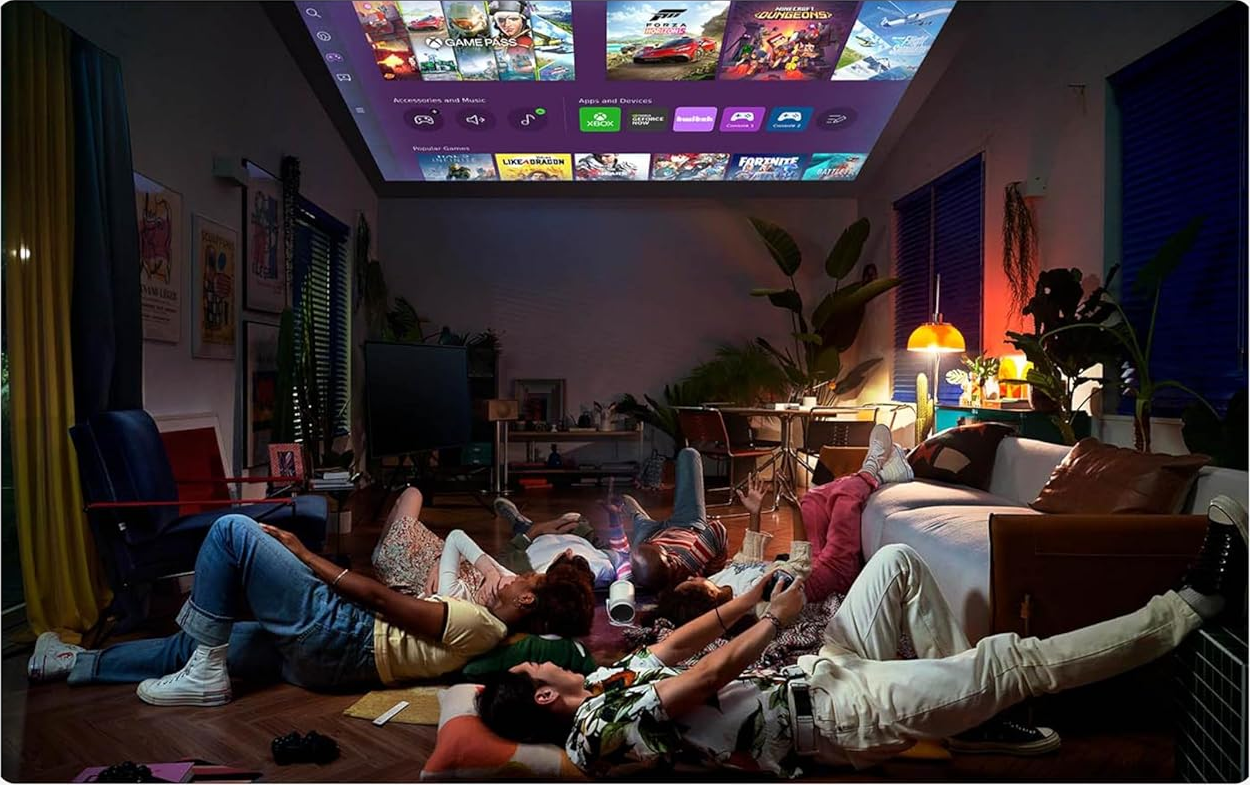
Yes, through HDMI for the lowest input lag. Wireless screen mirroring introduces enough latency to affect timing-sensitive games, particularly competitive multiplayer and rhythm games. For Switch, PS5, and Xbox play, HDMI is the reliable connection.
Check the projector’s input lag specification before buying for gaming use specifically: anything below 30ms is acceptable for casual gaming, and below 16ms is the target for competitive play.