Sewing machines have changed fast. Features like touchscreens, smart stitches, and auto tension are now common. Still, many people prefer mechanical models for their durability and simplicity.
The best machine depends on what you make. Beginners need something basic, while heavy or frequent use demands more power. Choose wrong, and you’ll either overspend or hit limits quickly.
What Makes a Great Sewing Machine?
Stitch consistency under varying fabric weights is the clearest indicator of machine quality. It separates machines with adequate motors from those that skip, pucker, or lose tension when the fabric gets demanding.
Motor torque determines what fabrics the machine can actually handle: standard motors manage quilting cotton and lighter garment fabrics comfortably, while heavy-duty motors are the difference between a clean stitch through denim and a needle that bends or breaks mid-seam.
User interface matters more for beginners than experienced sewers. Automatic needle threaders, one-step buttonholes, and LCD stitch guides remove the two most frustrating barriers to starting a project.
Best Sewing Machines for Home Use, Quilting, Heavy Fabrics, and Embroidery
The six machines below cover the full range, from a computerized quilting and general-purpose machine that handles 70 stitch types with an LCD interface, to a purely mechanical workhorse that prioritizes decades of reliable operation over digital features.
Each was chosen based on stitch quality, motor performance under load, and how well the feature set matches a specific skill level and sewing discipline.
1. Janome Lovely Lilac
Best for beginners

Most beginner sewing machines make a quiet compromise on build quality to hit an entry price point. Plastic frames, lightweight construction, and components that develop wobble after a few months of use.
The Lovely Lilac’s interior metal frame is the detail that separates it from that category. The external casing is standard, but the structural chassis is metal, which keeps the machine stable during operation and maintains stitch consistency over years of use rather than months.
Fifteen built-in stitches is the right number for a beginner; enough variety to handle basic garment construction, repairs, and simple patchwork without the decision paralysis that comes with navigating 70-stitch menus before you’ve learned what each one does.
The four-step buttonhole is more manual than the one-step versions on computerized machines, but working through the steps builds understanding of how buttonholes are constructed rather than treating it as a black box automatic process.
Tutorial video access supports independent learning during the setup and first-project phase.
Type: Mechanical | Key specs: 15 built-in stitches, 4-step buttonhole, interior metal frame, tutorial video access
Pros:
- The interior metal frame provides structural stability that most beginner machines at this price point lack. Holds stitch consistency over years rather than developing operational wobble
- 15-stitch range covers all fundamental sewing techniques without overwhelming a new user with options they’re not ready to use
- Charming aesthetic and approachable setup make it a practical first machine for children, teens, and adults starting from zero experience
Cons:
- No automatic needle threader. Manual threading is a skill worth learning, but it adds friction during setup for users with limited dexterity or vision
- Stitch variety tops out at 15, which becomes a limitation as skills develop and project complexity increases
Verdict: The most durable beginner sewing machine available at entry-level pricing. The metal frame means it’s a machine that will still perform well in five years rather than one that gets replaced after a few months of regular use.
2. Brother CS7000X
Best overall sewing machine
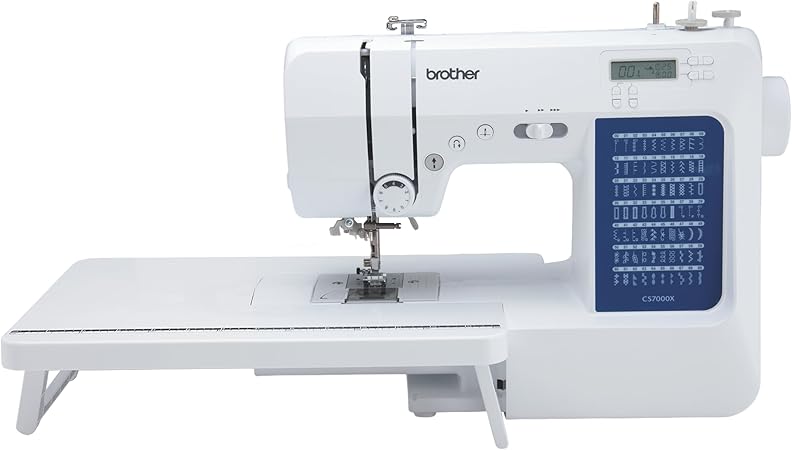
The CS7000X earns the overall pick by covering more use cases competently than any other machine at this price.
Seventy built-in stitches handle everything from basic straight seams and zigzag finishing to decorative and quilting stitches without requiring a stitch library upgrade.
The LCD display shows which presser foot to use for each selected stitch; a detail that functions as a built-in instructor for newer sewers who haven’t yet memorized foot-to-stitch relationships.
The drop-in top bobbin loads faster and runs quieter than front-loading bobbin systems, which matters during long sewing sessions where frequent rebobbining interrupts workflow.
The included wide extension table changes what’s achievable on larger quilting and home decor projects. Working with a queen-sized quilt on a standard machine arm is a frustrating experience that the wide table resolves.
At 10.5 lbs, it’s the lightest machine on this list, which makes transporting it to a class or a friend’s workspace practical rather than an ordeal.
Type: Computerized sewing and quilting | Key specs: 70 built-in stitches, LCD display, 750 stitches/min, automatic needle threader, drop-in top bobbin, 10 presser feet included
Pros:
- LCD stitch guide displays the correct presser foot for each stitch selection. Functions as a built-in reference that reduces setup errors for less experienced users
- Drop-in top bobbin system loads faster and operates quieter than front-loading oscillating hook systems during sustained sewing sessions
- Wide extension table included in the box. Meaningful for quilting and larger home decor projects that exceed standard arm capacity
Cons:
- Mostly plastic frame construction. Handles standard fabrics well but flexes under sustained pressure from very thick materials like heavy canvas or leather
- Not the right machine for users whose projects regularly involve multiple layers of heavy fabric
Verdict: The most practical all-purpose home sewing machine at this price. For 90% of home sewing projects — garment repairs, quilting, home decor, and general construction — the CS7000X covers the full range without requiring a machine upgrade.
3. Singer Heavy Duty 4423
Best heavy-duty machine

The 4423’s motor is 50% more powerful than standard home sewing machine motors, and that power differential is immediately noticeable when the fabric gets demanding.
Standard machines slow perceptibly through thick denim layers, double-folded seams, and upholstery fabric. The 4423 drives through at 1,100 stitches per minute without the motor strain that produces skipped stitches and bent needles on lighter machines. The stainless steel bedplate provides a smooth, consistent fabric feeding surface that standard painted steel plates don’t match for heavy material handling.
The heavy-duty metal frame eliminates the frame flex that affects plastic-chassis machines when the needle penetration force increases on thick materials.
Maintenance is straightforward: the mechanical system is accessible and repairable without specialist knowledge or proprietary tools, which matters for a machine expected to run hard for years.
The mechanical dials lack the precision of LCD stitch selection, but for a machine primarily used on denim, canvas, and upholstery, the 23 available stitches cover the relevant range without needing digital navigation.
Type: Mechanical heavy-duty | Key specs: 23 built-in stitches, 1,100 stitches/min, heavy-duty metal frame, stainless steel bedplate
Pros:
- Motor produces 50% more torque than standard home machines. Handles multiple denim layers, upholstery fabric, and heavy canvas without speed reduction or needle deflection
- 1,100 stitches per minute is the fastest machine on this list. It covers high-volume production work that would exhaust a standard home machine motor over time
- Stainless steel bedplate feeds heavy fabric more consistently than painted steel surfaces, which drag slightly under high-friction materials
Cons:
- Mechanical dial stitch selection is less precise than LCD interfaces for decorative and specialty stitches. Primarily a limitation for embellishment work rather than construction sewing
- Noise level at high speeds is the loudest on this list. Noticeable in shared living spaces during sustained high-speed operation
Verdict: The machine is for users whose projects regularly involve heavy fabrics that standard home machines can’t handle reliably. Denim tailoring, leather work, canvas bags, and upholstery repair all fall within its operating range without the motor strain that limits lighter machines.
4. Brother XR3774
Best budget option

The XR3774 makes a strong case that budget positioning doesn’t have to mean a bare-minimum feature set.
Thirty-seven built-in stitches at this price point cover basic repairs, simple garment construction, and entry-level quilting without requiring a mid-range machine purchase to access those techniques.
The one-step auto-size buttonhole handles one of the more technically demanding basic sewing tasks automatically, a feature that more expensive mechanical machines require manual four-step execution to complete.
The included wide table and eight sewing feet add practical value that would cost extra on competing budget machines. Tension adjustment can be inconsistent and may require more manual calibration than the Janome or Singer machines, which is the clearest indication of the budget positioning in actual use.
For occasional home repairs and casual hobbyist projects where the machine isn’t running daily, that limitation is manageable. For users planning frequent or demanding use, the tension inconsistency becomes more significant.
Type: Mechanical | Key specs: 37 built-in stitches, one-step auto-size buttonhole, wide table included, 8 sewing feet, easy-to-use needle threader
Pros:
- 37 stitches at budget pricing covers a significantly wider range of techniques than competing machines at the same price point. Bridges basic repairs and entry-level creative sewing
- One-step auto-size buttonhole automates the technique that causes the most frustration for beginner and intermediate sewers on manual machines
- Wide table and eight presser feet included in the box add functional value without an additional accessory purchase
Cons:
- The build feels less substantial than the Janome and Singer machines at comparable prices. Lighter construction is perceptible during handling and operation
- Thread tension requires more manual calibration than machines with better-engineered tension systems. Finicky tension adjustment is the most common user complaint
Verdict: The right entry point for budget-conscious hobbyists who want access to a wider stitch range than basic mechanical machines provide without stepping up to mid-range pricing. For occasional use and creative exploration, it covers the fundamentals reliably.
5. Janome 2212
Best mechanical reliability

The Janome 2212 makes no concessions to digital convenience, and that’s its specific appeal.
Twelve stitches selected by physical dials, front-loading bobbin, free arm for cuffs and sleeves, and a mechanical system that runs the same way on day one as it does on day five thousand.
For users who want a machine that will still perform consistently in twenty years with basic maintenance (regular cleaning, occasional oiling, and periodic timing checks), the 2212 is the machine for that expectation.
The front-loading bobbin and oscillating hook system produces stitch tension that experienced sewers often prefer over drop-in systems for precision garment work. The manual buttonhole is four steps rather than one, which requires more operator involvement but produces consistent results once the technique is learned.
The 2212 doesn’t have an automatic needle threader, which is a genuine daily inconvenience. A needle threader tool costs a few dollars and resolves it practically, but it’s worth knowing before buying.
Type: Mechanical (front-loading) | Key specs: 12 built-in stitches, dial stitch selection, front-loading bobbin, free arm for sleeves and cuffs
Pros:
- Front-loading bobbin and oscillating hook system produces consistent, high-quality stitch tension that experienced sewers prefer for precision garment construction
- A mechanical system with no electronic components has no circuit failure risk. The machine is fully repairable with standard tools and widely available parts
- Free arm configuration handles cuffs, sleeves, and trouser hems that flat-bed machines require repositioning to access
Cons:
- Twelve stitches is the most limited range on this list. Decorative stitching, specialty techniques, and quilting patterns require a different machine
- Manual four-step buttonhole requires more technique and attention than one-step computerized alternatives. A real learning curve for users new to manual buttonhole construction
Verdict: The machine for users who prioritize twenty-year reliability over digital convenience. If consistent stitch quality, full mechanical repairability, and decades of predictable operation matter more than stitch variety and automatic features, the Janome 2212 is the clearest choice on this list.
6. Brother SE700
Best smart and embroidery combination

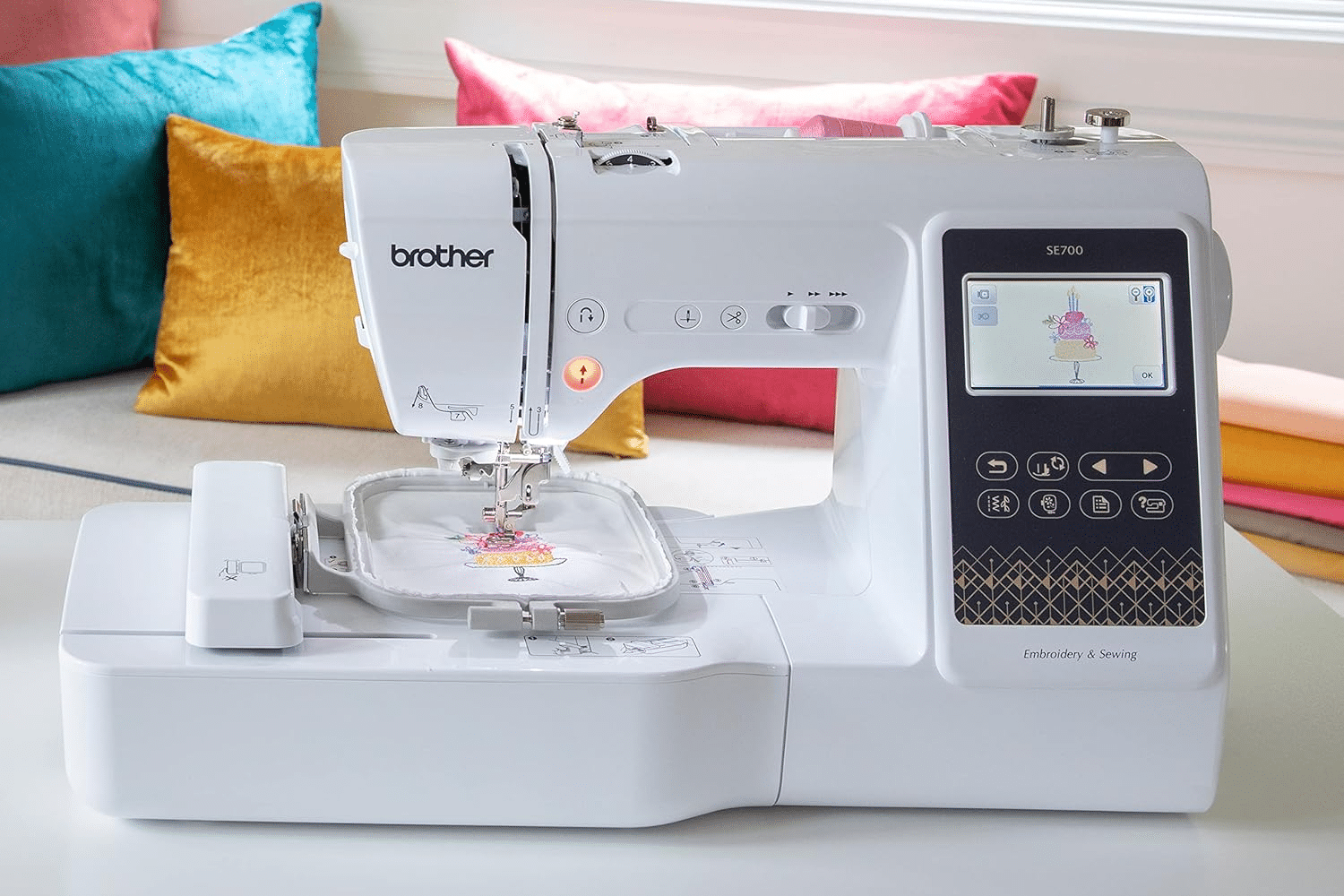
The SE700 is built around wireless connectivity in a way that changes what a home embroidery machine can do.
Wireless LAN transfer sends embroidery designs from a phone, tablet, or PC directly to the machine without USB drives or card readers. The workflow between designing on screen and stitching on fabric is the most seamless in the home embroidery category at this price.
The 3.7-inch color touchscreen displays design previews, stitch selection, and setup guidance with enough clarity that navigating 135 built-in designs and 103 stitches doesn’t require cross-referencing a manual.
The 4×4-inch embroidery area covers monogramming, logo work, and design placement on garments and accessories.
Large-scale embroidery projects that exceed that hoop size require repositioning and alignment work. The SE700 handles it, but it adds time and precision demands that a machine with a larger embroidery area avoids.
The LED lighting array eliminates the shadow problems that single-point lighting creates during detailed embroidery work, where seeing exactly where the needle is landing matters.
Type: Computerized sewing and embroidery | Key specs: 135 built-in designs, 103 stitches, 4×4 inch embroidery area, 3.7-inch color touchscreen, wireless LAN connectivity
Pros:
- Wireless LAN design transfer sends embroidery files from any device to the machine without physical media. The most streamlined design-to-stitch workflow in the home embroidery category
- 3.7-inch color touchscreen provides design preview and stitch guidance with enough display quality to navigate complex embroidery setups without external reference
- LED lighting array eliminates needle-area shadows during detailed embroidery work. Better visibility than single-point lighting on standard machines
Cons:
- 4×4-inch embroidery hoop limits large-format design work. Projects requiring larger embroidery areas need repositioning and alignment, which adds complexity and time
- The highest price on this list, and the learning curve for embroidery software and file management is steeper than any other machine here
Verdict: The right machine for hobbyists who want to personalize clothing, accessories, and home goods with custom embroidery and aren’t willing to choose between a capable sewing machine and a capable embroidery machine. The wireless connectivity and touchscreen interface make it the most technically current machine on this list.
Comparison Table: The Top 6 Sewing Machines
| Machine | Type | Stitches | Best for | Weight |
| Brother CS7000X | Computerized | 70 | Overall value | 10.5 lbs |
| Janome Lovely Lilac | Mechanical | 15 | Beginners | 12 lbs |
| Singer Heavy Duty 4423 | Heavy duty | 23 | Thick fabrics | 14.5 lbs |
| Brother XR3774 | Mechanical | 37 | Budget/variety | 12.3 lbs |
| Janome 2212 | Mechanical | 12 | Reliability | 13.2 lbs |
| Brother SE700 | Smart combo | 103 | Embroidery | 21.6 lbs |
How to Choose the Best Sewing Machine
Mechanical vs. computerized
Mechanical machines are controlled by physical dials and levers. They’re straightforward to maintain, repairable with widely available parts and standard tools, and produce consistent stitch quality that doesn’t depend on software or electronic components staying functional.
The tradeoff is manual operation. Tension, stitch length, and width all require physical adjustment rather than preset selection.
Computerized machines handle those adjustments automatically and offer stitch libraries, programmable settings, and LCD guidance that reduces the learning curve significantly.
The electronic components do introduce a failure mode that mechanical machines don’t have, and repair often requires manufacturer service rather than a local technician.
Motor power and fabric compatibility
Standard home machine motors handle quilting cotton, linen, light denim, and most garment fabrics without difficulty. Multiple layers of heavy denim, upholstery fabric, canvas, and leather require a motor with meaningfully more torque.
The Singer Heavy Duty 4423’s motor specification exists specifically because standard motors stall, skip stitches, or bend needles on those materials.
If your planned projects regularly involve thick or layered heavy fabrics, heavy-duty branding, and a metal interior frame are the two specifications worth confirming before buying.
Automatic features for beginners
Two features eliminate more beginner frustration than any other: the automatic needle threader and the one-step buttonhole. Threading a needle by hand is manageable once you’ve done it hundreds of times.
For a new sewer doing it for the first time, it’s a barrier that delays getting to the actual sewing. A one-step buttonhole removes the sequencing complexity of a four-step manual buttonhole, producing consistent results without needing to learn the underlying technique first.
Noise levels and bobbin systems
Top drop-in bobbin systems load faster and run quieter than front-loading oscillating hook systems during sustained operation. For apartment use and shared living spaces, that noise difference is worth considering alongside the machine’s motor noise at operating speed.
Front-loading systems often produce better stitch tension for precision garment work. Experienced sewers frequently prefer them for that reason, despite the additional noise.
For most beginners and casual hobbyists, the drop-in system’s convenience and quieter operation are the more practical priority.
Frequently Asked Questions
What is the best sewing machine for beginners?
The Brother CS7000X handles most beginner needs better than any other machine on this list. The LCD stitch guide tells you which presser foot to use for each selected stitch, the automatic needle threader removes the most frustrating manual setup step, and the 70-stitch range grows with skill level rather than becoming a limitation within a few months.
The Janome Lovely Lilac is the better choice if build longevity and mechanical simplicity matter more than digital features.
Are computerized sewing machines actually better than mechanical ones?
For most home users, computerized machines are more convenient and accessible. Automatic tension, stitch menus, and guided setup reduce the manual knowledge required to produce good results.
Mechanical machines are more durable long-term, fully repairable without specialist support, and preferred by experienced sewers who want direct physical control over every machine setting.
The right answer depends on whether you prioritize convenience and feature access or repairability and long-term mechanical reliability.
Can a standard sewing machine handle denim and leather?
Standard motors handle light denim and single layers of medium-weight fabric adequately.
Multiple denim layers, full-grain leather, heavy canvas, and upholstery fabric require a heavy-duty motor and a metal interior frame to prevent stalling, needle deflection, and frame flex under increased penetration force.
The Singer Heavy Duty 4423 is specifically engineered for those materials. Standard machines are not, regardless of what the product description implies.
How long do sewing machines actually last?
A well-maintained mechanical machine, with regular cleaning, periodic oiling, and professional timing checks every few years, lasts 20 to 30 years without significant degradation.
The Janome 2212 is a realistic example of that lifespan. Computerized machines typically last 10 to 15 years before electronic component failures or discontinued software support become practical limitations.
The longevity gap between mechanical and computerized machines is real and worth factoring into a buying decision if decades of reliable use is a priority.
Which Sewing Machine Is Best for You?
For the vast majority of home sewers who want one machine that handles repairs, garment construction, and quilting without technical barriers, the Brother CS7000X covers the full range at a price that’s difficult to argue against.
For users whose projects regularly involve heavy fabrics (denim, canvas, upholstery, or leather), the Singer Heavy Duty 4423‘s motor and metal frame are the only combination on this list built for that sustained demand.
For users who want decades of reliable mechanical operation with minimal maintenance and no electronic failure risk, the Janome 2212 is the clearest long-term investment on this list.
For hobbyists who want to personalize garments and accessories with custom embroidery and need wireless design transfer to do it efficiently, the Brother SE700 is the machine that makes that workflow practical at home.